Lammhults Design Group LAMM B

Investor primer dated 2026-05-28

The sales multiple is cheap. The EBIT still has to earn it.

Lammhults Design Group is a real Swedish listed interiors business with almost SEK 0.9bn of annual sales. The investment case is not whether the company exists. It is whether Office can stabilize, Library can convert backlog, and the group can turn a respectable gross margin into durable cash earnings for minority B-shareholders.

FY2025 sales SEK 878.5m
FY2025 adj. EBIT SEK 27.8m
Q1 2026 adj. EBIT SEK 0.9m
Working EV SEK 331.6m
EV / sales 0.38x

Thesis

A margin case disguised as a value stock.

Lammhults Design Group AB (publ) is listed on Nasdaq Stockholm Small Cap, but the practical investor experience is closer to a small, thinly traded microcap. The group has real products, real brands, audited IFRS reporting, a dividend, two operating areas and a revenue base that many smaller companies would envy. That does not make the equity cheap by itself.

The equity only becomes compelling if the current revenue base can produce more EBIT and better free cash flow than recent reporting has shown. FY2025 adjusted EBIT margin was 3.2%. Q1 2026 adjusted EBIT margin was 0.4%. Management may speak about 8-10% EBIT margin over time, but the delivered numbers do not yet allow that target into the base case.

The constructive reading: the sales base is already there, adjusted gross margin held at 36.3% in Q1 2026, Library order intake rose 23.8%, Library backlog rose 30.6%, and even a mid-single-digit EBIT margin can move equity value sharply because the share count is small.

The skeptical reading: Office order intake fell 16.3% in Q1, group adjusted EBIT was only SEK 0.9m, Q1 free cash flow including leases was negative, and net debt of SEK 133.1m is large relative to a roughly SEK 198.5m market cap.

The chairs can be well designed. The investment case is the EBIT drop-through.

Business

Two segments, one proof burden.

The group operates through Office Interiors and Library Interiors. Office is the larger segment and sells furniture and interior products into offices, public spaces, education, hospitality and contract settings. Library is more specialized, with shelving systems, library interiors, furniture, media handling and related public-institution solutions.

This is not a software business with recurring subscriptions. It is a product and project business where order intake, tender timing, public budgets, distributor confidence, capacity utilization and working capital matter. The revenue line is understandable, but it is not highly predictable. The quality of backlog and the cash collection behind it are as important as the headline sales number.

Office Interiors

Office generated FY2025 sales of SEK 578.8m and operating profit of SEK 29.8m. In Q1 2026 it reported sales of SEK 140.6m, order intake of SEK 122.4m and backlog of SEK 134.7m. The problem is direction: Q1 order intake was down 16.3%, while backlog was only up 2.1%.

Because Office is the larger segment, stabilization here is not a nice add-on. It is the main operating requirement. Weak orders also create idle-capacity pressure, which makes gross margin and EBIT less forgiving.

Library Interiors

Library generated FY2025 sales of SEK 301.7m and operating profit of SEK 17.1m. In Q1 2026 it reported sales of SEK 67.7m, order intake of SEK 84.0m and backlog of SEK 97.6m. Order intake rose 23.8% and backlog rose 30.6%.

This is the strongest current positive signal in the file. It still has to become revenue, segment profit and cash. Backlog is evidence, not money in the bank.

Group economics

FY2025 group sales were SEK 878.5m, but adjusted EBIT was only SEK 27.8m and reported EBIT was SEK 16.0m. Q1 2026 sales were SEK 207.8m, while adjusted EBIT was only SEK 0.9m.

The gross margin base is better than the EBIT line suggests. The real question is whether cost actions, volume mix and capacity utilization can make more gross profit survive below the operating line.

Financial tape

Revenue is not the scarce asset. Profit conversion is.

FY2025 showed the tension in one year. Net sales were real, gross profit existed, operating cash flow was strong, and the board approved a SEK 1.00 per share dividend. But reported profit after financial items was SEK 8.2m, net profit was SEK 4.6m, and the reported earnings base does not support an easy value conclusion.

Q1 2026 then made the debate harder. Sales were SEK 207.8m, adjusted gross margin was 36.3%, order backlog was up 12.4%, and yet adjusted EBIT was SEK 0.9m. Free cash flow including leases was negative SEK 15.9m. Net debt rose to SEK 133.1m, while available liquidity was SEK 73.6m and equity/assets was 55.4%.

Metric FY2025 Q1 2026 Investor read
Net sales SEK 878.5m SEK 207.8m A large enough base for operating leverage if margin recovery is real.
Adjusted gross margin 37.1% 36.3% Constructive resilience, but not enough without EBIT drop-through.
Adjusted EBIT SEK 27.8m SEK 0.9m The central proof point. Current level is too low for a clean buy case.
Operating cash flow SEK 71.8m SEK -11.2m FY2025 was strong, but Q1 reminds investors not to annualize it blindly.
Free cash flow including leases about SEK 42.2m SEK -15.9m Cash conversion must be tested through Q2 and Q3 after dividend effects.
Net debt SEK 117.7m SEK 133.1m Meaningful versus equity value; every SEK 10m matters per share.
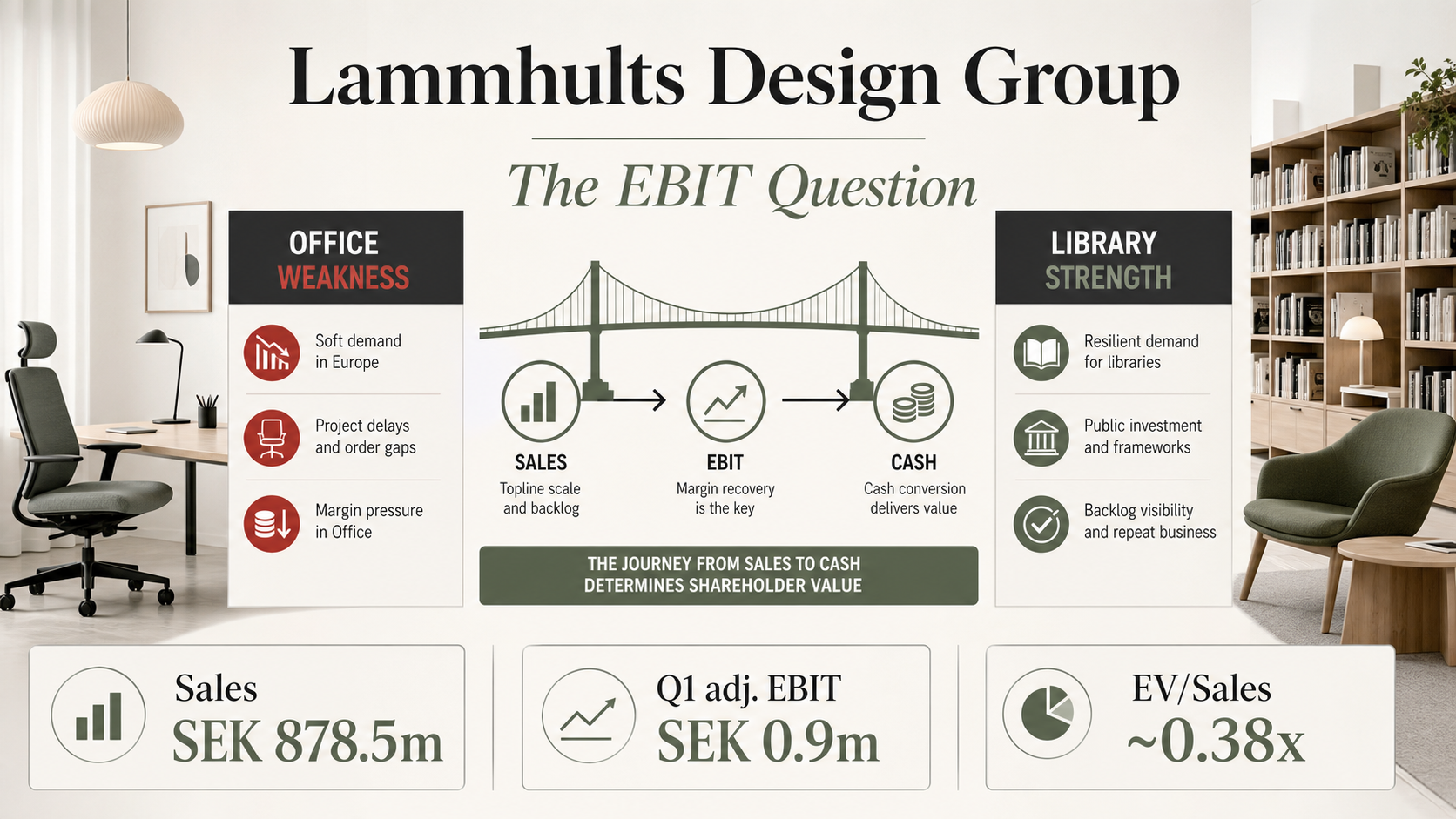
One page visual summary of the Lammhults Design Group investment case

One-page summary image generated for the Lammhults Design Group research package. It is included as a visual companion, not as a substitute for the figures above.

Valuation

The multiple only works after normalization.

At the working SEK 23.50 share price and about 8.448m ordinary shares, market cap is about SEK 198.5m. Add Q1 2026 net debt of SEK 133.1m and enterprise value is about SEK 331.6m. That gives EV/Sales of about 0.38x, which is optically low and therefore dangerous if used alone.

Against FY2025 adjusted EBIT of SEK 27.8m, EV/EBIT is about 11.9x. Against reported EBIT of SEK 16.0m, it is about 20.7x. That is why this is a margin-normalization case. The stock is not obviously cheap on delivered profit. It is potentially cheap if the company can move toward a mid-single-digit EBIT margin while debt falls.

Scenario frame

These scenarios are deliberately simple. They show how sensitive the equity is to EBIT margin and net debt, not how clever a spreadsheet can look after midnight.

Bear ~SEK 1.6/share

Sales of SEK 850m, EBIT margin of 2.5%, 7.0x EV/EBIT and net debt of SEK 135m. Office stays weak, Library disappoints, and equity value is compressed by debt.

Base ~SEK 32.7/share

Sales of SEK 900m, EBIT margin of 5.5%, 8.0x EV/EBIT and net debt of SEK 120m. Partial normalization creates value, but the case still deserves liquidity and control haircuts.

Bull ~SEK 69.5/share

Sales of SEK 940m, EBIT margin of 8.0%, 9.0x EV/EBIT and net debt of SEK 90m. This requires real delivery near management's ambition, not just a better paragraph in a report.

Share count

The headline bridge uses about 8.448m ordinary A+B shares. Upside scenarios should also be viewed on roughly 8.86-8.90m LTI-diluted shares, and an acquisition-mandate stress count can approach 9.66-9.70m before acquired economics.

Margin sensitivity

Every 1 percentage point of EBIT margin on FY2025 sales is about SEK 8.8m of EBIT, or roughly SEK 1.04 per ordinary share before tax and financing effects.

Debt sensitivity

Every SEK 10m change in net debt is roughly SEK 1.18 per ordinary share. That makes working capital, dividend timing and lease-adjusted debt central to the equity case.

Catalysts

The next reports have to do the talking.

The next hard test is the Q2/H1 2026 report on 2026-07-14. The follow-up test is Q3 2026 on 2026-10-23. These reports should not be read as normal quarterly maintenance. They are evidence gates for the entire investment case.

The reports need to answer a practical question: was Q1 a weak starting point in a recovery, or a fair picture of an under-earning company? The answer will be visible in Office order intake, Library conversion, gross margin, adjusted EBIT, reported EBIT, free cash flow, inventory, receivables and net debt.

Catalyst Timing What would help What would hurt
Q2/H1 2026 report 2026-07-14 Office orders stabilize, Library backlog converts, adjusted EBIT lifts from Q1, cash flow improves, net debt stops rising. Another low-EBIT quarter, weaker Office orders, poor cash conversion or higher debt after the dividend period.
Q3 2026 report 2026-10-23 Clear H2 evidence that cost actions and backlog are reaching the income statement. Management pushes recovery language further out while reported EBIT and cash remain thin.
Office stabilization 2026 H2 Order intake stops falling, backlog improves and idle-capacity language fades. Order decline continues and Office gross margin remains pressured.
Library conversion 2026 H2 The 23.8% order intake growth and 30.6% backlog growth become revenue, segment profit and cash. Backlog becomes revenue without EBIT, or cash is tied up in working capital.
Capital allocation Any time Deleveraging, disciplined dividend coverage and no low-quality share-funded deal. Use of the 800,000 B-share mandate for a vague acquisition before the core margin recovery is proven.

Risk

The bear case does not need a disaster.

The most important risk is not that Lammhults is imaginary. The source work does not support that. The more relevant risk is that the company remains a real, respected, low-margin interiors group that does not earn enough for equity holders after debt, leases, working capital and dilution.

That distinction matters. A fraud thesis would be dramatic and convenient. The likely downside is more boring: Office demand remains weak, Library backlog is less profitable than hoped, gross margin slips, restructuring adjustments recur, cash flow stays negative and net debt absorbs the value that looked available to shareholders.

Kill criteria

Two more quarters of falling Office order intake without gross-margin improvement would weaken the case. A group adjusted EBIT margin that does not move above low single digits during 2026 would remove the basis for using mid-single-digit EBIT in valuation. A gross margin break below roughly 35-36% without clean mix explanation would also matter.

Negative free cash flow after the dividend period, rising net debt above Q1 levels, another material impairment, or repeated restructuring costs would make reported earnings harder to trust. A share-funded acquisition with weak per-share economics would be another clear warning.

Minority and liquidity

Lammhults has A, B and C shares, concentrated voting power and microcap-like trading liquidity. That can be acceptable for a private investor with a small position and a long horizon. It is not acceptable to pretend the B share should trade at the same valuation as a liquid, widely followed quality compounder.

Illiquidity changes position sizing. A thinly traded stock can gap before an investor has time to react, and larger holders may become their own exit problem. That is not a footnote. It is part of the price one should be willing to pay.

Accounting and cash

Good enough reporting, still a cash conversion test.

Lammhults clears several basic quality checks that matter in smaller companies. It is a regulated listed company, reports under IFRS, publishes annual and interim reports, shows segment information and has no obvious public pattern of emergency share issues, convertible financing or promotional financing machinery in the source work. That is worth stating because many microcap-like situations fail before the financial model begins.

The harder question is not whether the accounts exist. It is whether reported progress becomes cash that belongs to shareholders. FY2025 operating cash flow of SEK 71.8m and free cash flow including leases of roughly SEK 42.2m were encouraging. But working capital was helpful in FY2025 and then moved against the company in Q1 2026, with a negative working-capital effect of SEK 15.7m. That swing is too large to ignore.

Adjusted versus reported

The analysis uses adjusted EBIT because it helps compare operating performance through restructuring and unusual items. Still, the reported number matters. FY2025 adjusted EBIT was SEK 27.8m, while reported EBIT was SEK 16.0m. When the earnings base is small, that gap is meaningful. If the company continues to rely on adjusted profit as the better-looking number, investors should demand more evidence before paying for a recovery.

The cleaner bullish pattern would be simple: adjusted EBIT rises, reported EBIT rises in the same direction, free cash flow improves, and net debt falls. If only adjusted EBIT improves while reported EBIT remains weak, the market is likely to keep applying a discount. That would be rational, not harsh.

Balance sheet reality

Q1 2026 net debt of SEK 133.1m is manageable relative to the operating business, but it is large relative to the equity value. Cash was SEK 6.1m, available liquidity was SEK 73.6m and equity/assets was 55.4%. That combination argues against an immediate distress framing, but it also makes deleveraging part of the investment case.

Leases should not be waved away. They are economic commitments tied to the business. Using net debt including lease effects is the right conservative base for enterprise value and downside work. A lower debt interpretation might make the share look neater, but neatness is not analysis.

Inventory

Inventory is not just a working-capital line. In a product and project business it signals demand confidence, production timing and risk of future margin pressure. Rising inventory without corresponding order conversion would make the Q1 weakness more concerning.

Receivables

Receivables matter because strong backlog is only valuable after delivery and collection. Library can have a good order book and still disappoint if cash conversion lags or payment terms stretch.

Goodwill and brands

Goodwill and other intangibles are substantial, and a material impairment occurred in 2024. New impairment risk is not the main bear case, but it would weaken confidence in historical capital allocation and the carrying value of acquired assets.

Ownership and dilution

Per-share math needs the dull details.

The headline share count used in the valuation bridge is about 8.448m ordinary A+B shares. That is appropriate for the working market-cap calculation and the dividend bridge. It is not the only share count an investor should keep in mind. The legal share context after known C-share mechanics is slightly higher, and LTI-diluted upside scenarios should use roughly 8.86-8.90m shares.

The AGM authorization for up to 800,000 new B shares for acquisitions is also important. It does not mean dilution will happen, and it could be value-creating if used for a genuinely accretive acquisition. But in a company where current EBIT conversion is weak, issuing shares for a vague strategic deal before the core business has proven recovery would be a serious red flag.

Control

The A/B structure and concentrated votes mean B-share minorities have limited practical influence. Concentrated owners can support long-term discipline and prevent panic decisions, but they can also leave minorities with little control over dividends, acquisitions, board composition or patience with slow recovery.

This is not unusual in Swedish small caps. It is still a valuation input. Control concentration deserves a discount unless the governance record and capital allocation are clearly superior.

Liquidity

Trading liquidity is microcap-like. The area work indicated average daily turnover around SEK 475,000 in Q1 2026. That can work for small private positions, but it is not deep. A larger investor may need time to enter or exit without moving the price.

Liquidity risk is not theoretical. It affects position sizing, required return and the credibility of any stop-loss plan. In a thin share, the exit may be the part of the thesis that refuses to fit into a spreadsheet.

Incentives

LTI-related dilution can be acceptable if it is tied to real value creation. The problem is not incentives in themselves. The problem would be paying management and dilution costs while the shareholder sees little reported EBIT, little cash conversion and no reduction in net debt.

For this case, incentive alignment should be judged after the next reports. If Office stabilizes, Library converts and the margin moves, dilution is less troubling. If not, even small dilution feels expensive.

Monitoring plan

What the next two reports must prove.

The first evidence gate is Q2/H1 2026 on 2026-07-14. The second is Q3 2026 on 2026-10-23. An investor does not need heroic growth to make the base case work. The company needs a sequence that proves the Q1 weakness was not the normal state of the business.

The correct monitoring frame is operating, not promotional. Look for Office order stabilization, Library delivery and segment profit, group adjusted gross margin in the 36-37% area, adjusted and reported EBIT improving together, working capital becoming less hostile and net debt beginning to move down. Any management commentary should be tested against those lines.

Area What to read Constructive evidence Negative evidence
Office Order intake, backlog, gross margin and comments on idle capacity. Order intake no longer falling, backlog stabilizing, gross margin recovering from Q1 pressure. Another material order decline, weak backlog and continued idle-capacity language.
Library Conversion of Q1's stronger orders and backlog into sales, EBIT and cash. Revenue growth with healthy segment profit and no ugly receivables build. Backlog converts into low-margin revenue or cash is trapped in working capital.
Gross margin Group adjusted gross margin and segment mix. Group margin holds around 36-37% while sales normalize. Margin falls below roughly 35-36% without a clean temporary explanation.
EBIT Adjusted EBIT, reported EBIT and bridge items. Both adjusted and reported EBIT improve from the Q1 trough. Progress exists only in adjusted numbers, while reported EBIT remains thin.
Cash and debt Operating cash flow, capex, lease payments, dividend effect and net debt. Free cash flow improves and net debt trends below SEK 133.1m after seasonal effects. Cash burn continues, available liquidity tightens or net debt rises materially.

Before proof: the stock offers more upside if the investor is right, but the probability is lower. That means position sizing should be conservative and the thesis should be written down before the Q2 report, not reinvented after the fact.

After proof: the price may be higher, but the uncertainty may be lower. Paying more after better evidence can be rational in a thin small-cap, especially when the downside is driven by debt and low EBIT.

Market read

What might be mispriced, and what might not.

The optimistic mispricing argument is not that Lammhults is secretly a growth company. It is that the market may be extrapolating current low EBIT too far. The company already has sales, gross profit, brands and a Library backlog signal. If the cost base has been reset and Office weakness moderates, a move from roughly 3% EBIT margin toward 5-6% can create a large percentage increase in earnings.

The skeptical counterargument is equally reasonable: the market may understand the potential but refuse to pay before evidence arrives. Many cyclical and project-exposed companies can look cheap at the point when investors are asked to trust a recovery. The market has seen enough cost programs, margin ambitions and second-half recovery language to demand delivered numbers.

The case for asymmetry

At a roughly SEK 198.5m market cap, a modest EBIT improvement can matter. Moving from FY2025 adjusted EBIT of SEK 27.8m to a base scenario EBIT of SEK 49.5m is an incremental SEK 21.7m. At 8.0x EV/EBIT, that incremental EBIT alone represents a meaningful enterprise value swing before considering debt reduction.

This is why the share can be interesting even without heroic revenue growth. If sales are near SEK 900m and gross margin holds, better capacity utilization and cost discipline can do much of the work. The equity market often reacts late to margin inflection in illiquid names with limited coverage.

The case for waiting

The same leverage works against shareholders. If EBIT remains around SEK 20-30m and net debt stays above SEK 130m, much of the enterprise value belongs economically to creditors and leases before equity gets excited. The bear scenario does not require collapse. It only requires low EBIT conversion to persist.

Waiting for Q2 or Q3 can therefore be rational. The investor may lose the lowest entry price, but gain better evidence on Office, Library, cash and debt. In a liquid mega-cap, that trade-off may feel too cautious. In a thin controlled small-cap, it is often simply practical.

A low sales multiple is not a margin of safety when the margin is exactly what has not been proven.

Podcast

Audio memo for the same case.

The companion episode turns the research into a spoken investor memo: what the company does, why the low sales multiple is tempting, why current EBIT is not good enough, and what Q2 and Q3 must prove. The tone is intentionally skeptical because this is a thinly traded turnaround, not a pitch deck with better chairs.

The audio file is referenced with a relative path so the publishing script can include it once the MP3 has been rendered into this analysis folder.

Lammhults Design Group: The Cheap Sales Multiple That Still Needs EBIT

A roughly 30-minute investor conversation on margin normalization, Office weakness, Library backlog, debt sensitivity and the July and October 2026 evidence gates.

Download or listen to the podcast MP3

Final view

Watchlist to selective buy, not blind value.

The council judgement classifies Lammhults as a conditional small-cap turnaround with microcap trading risk. That is the cleanest label. The company has sufficient substance to justify serious work: established brands, meaningful sales, a listed reporting framework, no obvious rescue-financing pattern, a credible Library signal and a valuation that can move sharply if EBIT normalizes.

But the company also has enough weakness to punish lazy optimism. Office is too important to ignore. Q1 adjusted EBIT was too weak to underwrite the long-term margin target. Working capital can move equity value. Net debt is material. Share structure and concentrated control reduce minority influence. Low trading liquidity raises the required margin of safety.

The investable version of the case needs evidence: Office order intake stabilizing, Library backlog converting profitably, adjusted gross margin holding around 36-37%, reported EBIT moving with adjusted EBIT, free cash flow returning and net debt falling. Without that, EV/Sales at 0.38x is not a bargain; it is just a number dressed up as a thesis.

Position sizing should follow that uncertainty. A small, patient investor can treat Lammhults as an evidence-driven recovery position, provided the maximum loss and slow exit are acceptable before the first share is bought. A larger investor may find the idea intellectually attractive but economically awkward because the liquidity does not support meaningful scale. That does not make the thesis wrong. It means the implementation has to respect the actual market in the share.
Sources

Primary source trail.

The figures in this primer are drawn from the local Lammhults research package and the primary company sources listed below. The SEK 23.50 share price is a working secondary quote used for valuation sensitivity on 2026-05-28, not an official closing price.